Automation and Artificial Intelligence (AI) are no longer emerging technologies—they are powerful forces reshaping global economies. For India, a country with a large workforce, growing digital infrastructure, and ambitious economic goals, automation and AI represent both an opportunity and a challenge. Their impact spans economic growth, employment patterns, productivity, and the quality of products and services, while global developments in countries like the United States and China offer valuable lessons.
Understanding Automation and AI
-
Automation involves using technology to perform repetitive or rule-based tasks with minimal human intervention.
-
Artificial Intelligence (AI) enables machines to learn from data, recognize patterns, make decisions, and improve over time.
Together, they power applications such as robotic process automation (RPA), predictive analytics, computer vision, natural language processing, and intelligent robotics.
Impact of Automation and AI on India
1. Impact on the Indian Economy
Automation and AI are becoming key contributors to India’s economic transformation. They support:
-
Faster industrial output
-
Lower operational costs
-
Increased competitiveness of Indian businesses globally
AI adoption across manufacturing, banking, healthcare, logistics, and agriculture is helping India move up the value chain—from cost-driven services to innovation-led growth. As digital capabilities mature, AI is expected to significantly boost India’s GDP over the coming decade.
2. Impact on Employment
Employment impact is often the most debated aspect of automation.
Challenges
-
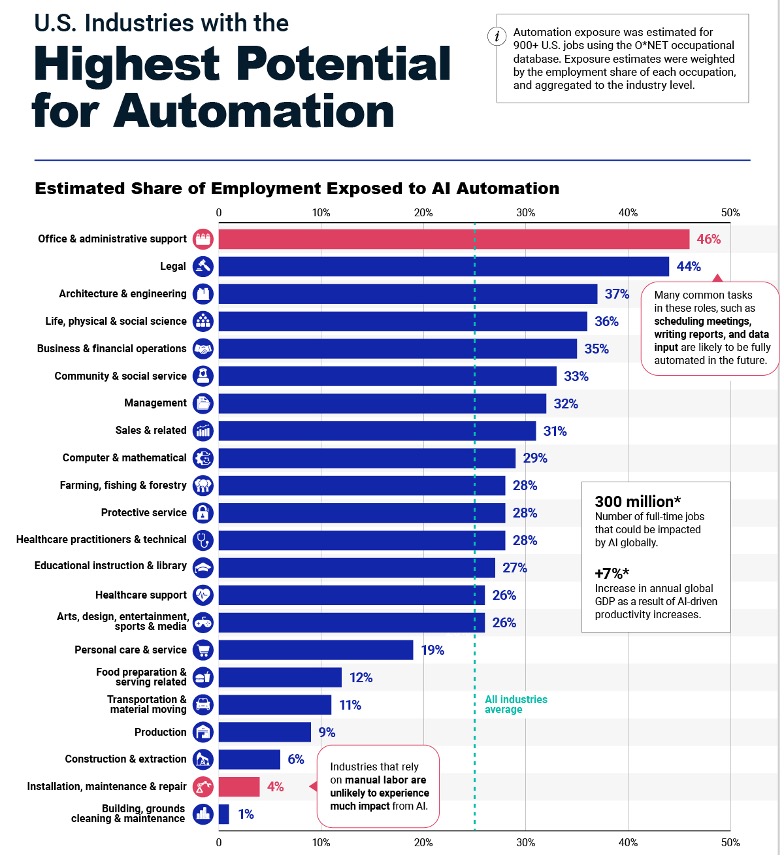
Routine, repetitive jobs—especially in manufacturing, data entry, and basic services—are at risk of displacement.
-
Low- and semi-skilled roles face higher automation exposure.
Opportunities
-
New roles are emerging in AI development, data science, cybersecurity, system integration, and digital operations.
-
Demand is growing for hybrid skills combining domain knowledge with digital expertise.
In India, the shift is not about job loss alone, but job transformation. The long-term employment outcome depends heavily on reskilling, upskilling, and education reforms.
3. Impact on Productivity
Automation and AI significantly enhance productivity by:
-
Reducing errors and rework
-
Enabling 24/7 operations
-
Accelerating decision-making with real-time insights
Indian organizations using AI-driven analytics and automation report higher output with the same or fewer resources. This productivity boost is especially important for SMEs aiming to scale without proportionally increasing costs.
4. Impact on Quality of Products and Services
AI-driven systems improve quality through:
-
Predictive maintenance reducing defects
-
Computer vision ensuring consistent quality checks
-
Personalized services in banking, retail, and healthcare
As a result, Indian consumers experience better reliability, faster service, and more customized offerings, while businesses gain stronger brand trust and customer satisfaction.
Global Perspective: Lessons from the USA and China


United States: Innovation and Enterprise AI
The United States leads in AI innovation, driven by:
-
Strong research universities and private investment
-
Advanced AI adoption in healthcare, finance, defense, and enterprise software
-
High use of automation to enhance productivity rather than replace skilled labor
The US model shows how AI can create high-value jobs, improve service quality, and strengthen global competitiveness when paired with innovation ecosystems.
China: Scale, Speed, and Industrial Automation
China has rapidly deployed automation and AI at scale:
-
Extensive use of robotics in manufacturing
-
Government-led AI strategies and infrastructure investment
-
AI-powered smart cities, logistics, and surveillance systems
China demonstrates how large-scale automation can dramatically improve productivity, reduce costs, and dominate global manufacturing—but also highlights the importance of managing workforce transitions.
What India Can Learn
From the USA and China, India can draw three critical lessons:
-
Invest in Skills – Continuous reskilling is essential to ensure inclusive growth.
-
Encourage Innovation – Strong collaboration between startups, industry, and academia accelerates AI adoption.
-
Adopt Responsible AI – Ethical use, data privacy, and transparency must be integral to AI strategies.
The Road Ahead for India
Automation and AI will play a decisive role in India’s ambition to become a global economic powerhouse. When aligned with education reform, digital infrastructure, and supportive policies, these technologies can:
-
Drive sustainable economic growth
-
Create higher-quality employment
-
Improve productivity across sectors
-
Deliver world-class products and services
Conclusion
Automation and AI are reshaping India’s economy—not by replacing human effort entirely, but by augmenting it. The experiences of the USA and China show that the real advantage lies in how strategically these technologies are deployed. For India, the future belongs to businesses and institutions that embrace automation and AI responsibly, invest in people, and focus on long-term value creation.
The challenge is real—but so is the opportunity.